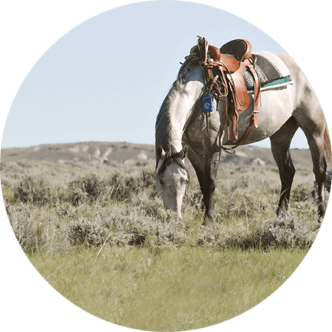
Striving for Excellence: Sinclair Cattle Company prioritizes functional cattle that work in diverse environments
With seedstock operations in both Wyoming and Pennsylvania, Sinclair Cattle Company is dedicated to producing Angus cattle which excel in efficiency, carcass quality and maternal traits, with a firm commitment to sustainability and excellence.
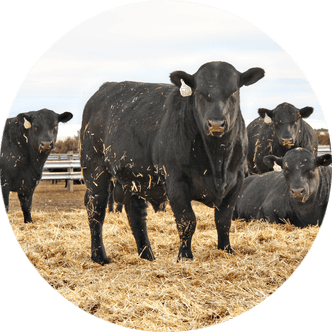
The company’s focus is on cattle that thrive on grass and produce high-quality beef raised in a sustainable and cost-effective manner.
Cattle at Sinclair Cattle Company are designed to perform well in both pasture and feedlot settings, offering a balanced set of traits appealing to commercial producers and purebred breeders alike.
At the core of this philosophy are functional females selected for fertility, longevity and efficiency under low-input management systems. Natural fleshing ability, maternal strength and carcass merit are prioritized to create cattle that work for a living.
Early years
According to Logan Baker, who has worked for Sinclair Cattle Company’s Wyoming ranch in several capacities since 2000 and now spends most of his time with the cow herd, the company was founded in the late 1990s by Duncan Smith, whose vision shaped the operation from the beginning.
“Duncan wanted to do something special with Angus cattle,” Logan explains. “So, he bought part of the N Bar cow herd and utilized the tools necessary to add on to the foundation to make it better.”
Logan notes N Bar cattle primarily stemmed from the Emulation bloodline, including the purchase of N Bar Emulation EXT, a bull which has had a profound influence on both the Sinclair herd and the Angus breed as a whole.
“EXT’s genetics helped solidify our base for producing cattle with exceptional carcass traits and maternal abilities,” Logan states.
Multiple operations
Today, Sinclair Cattle Company operates in two vastly different environments, providing a real-world test of adaptability and performance.
The Wyoming ranch is located near Buffalo, while the Pennsylvania ranch operates near the small town of Warfordsburg, Penn. – nearly 1,700 miles apart.
This geographic separation allows the company to evaluate how cattle perform under different climates, forage conditions and management systems, and Logan says cattle consistently rise to the challenge.
“Our cattle thrive and excel in a lot of places,” he states.
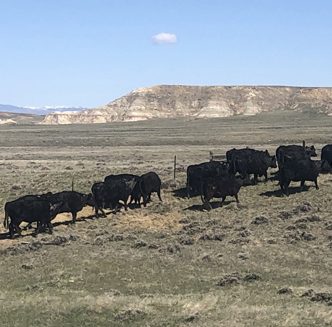
On the Wyoming ranch, cows begin calving in March. They are wintered on grass as long as conditions allow.
“They have to be efficient and able to work for a living,” Logan says. “I like to see them able to get out and travel to see if their feet and legs hold up.”
Approximately 400 cows calve each year in the Wyoming herd, and cows calve outside, typically never seeing a barn, though spring weather can vary drastically.
Branding is done the traditional way – rope and drag – a process Logan considers one of the highlights of the year.
“This is one of my favorite times of the year,” Logan shares. “It’s a traditional way ranchers get together to help each other and utilize their roping skills and good horses, and it’s also less stressful for the cattle.”
The event also reflects the strong sense of community in the region.
“We have a lot of handy people who come help us,” he adds. “There is a lot of neighboring that goes on in this part of the world. It’s a good tradition,” Logan says.
After branding, pairs are moved to grass in early May, grazing foothill and plains pastures around Buffalo and Sheridan. The short-grass country and large pastures require cattle to travel extensively.
All cows are artificially inseminated, then turned out with cleanup bulls. Weaning takes place in September, followed by the first sort of bull calves and replacement heifers.
Weaned bull calves are sent to Phil Veltcamp in Manhattan, Mont. for development.
“Phil is a master at developing bulls and expressing their genetic potential without overcooking them,” Logan says. “He has a very fine-line, carefully-balanced feeding program to determine growth potential without making them too fat or unsound.”
He notes avoiding excessive fat is critical for fertility and soundness, and this kind of careful balance in feeding programs ensures bulls stay functional.
Replacement heifers are also properly developed, with some sold as open commercial yearling heifers at Sinclair Cattle Company’s annual bull sale.
“Many people really like our heifers because they have very good luck with them,” Logan states.
Calves are preconditioned and vaccinated when cows are worked and ultrasound pregnancy checked in early September. Once weaned, calves are weighed, sorted and shipped to their next destination.
Herd improvements
Logan reiterates Sinclair Cattle Company based its cow herd on EXT genetics, utilizing linebreeding to concentrate on desirable traits while removing the undesirable ones.
“We concentrated his bloodline, keeping the good ones and getting rid of the undesirables, fine-tuning the front end of the gene pool,” Logan explains.
Having a strong genetic anchor made it possible to stack traits intentionally and build a consistent, predictable cow herd. Logan notes selection pressure continues to be applied to ensure steady improvement.
“We continue to apply selection pressure to make sure we are always improving our cows. The maternal side is of utmost importance. Without a good cow, you can’t produce the beef. It all starts with the cow,” he emphasizes.
Logan points out, in some cases, the pursuit of fast growth or carcass traits overshadows maternal fundamentals, but Sinclair Cattle Company’s philosophy remains clear – before anything else, cattle must be functional.
“Before you can really do anything in the beef industry, you first need to have a cow that gets pregnant every year and does a good job raising her calf,” he states.
“Some things in the beef industry seem to come and go in cycles, and people tend to forget about the importance of maternal traits, then they are reminded within a generation or two when their cattle can’t do what’s necessary,” Logan continues. “At Sinclair Cattle Company, we strive for optimum, not extremes. Sometimes the best thing to do as a breeder is say, ‘No, that’s enough.’”
Customer relationships
For Logan and the rest of the Sinclair Cattle Company team, customer relationships are as important as cattle performance.
“It’s a pleasure to visit and work with our customers,” he says. “We enjoy meeting new customers and treasure the relationships of our long-time customers.”
Through disciplined selection, functional cattle and a commitment to maternal strength, Sinclair Cattle Company continues to strive for excellence, producing Angus cattle designed to work across diverse operations and multiple states.
For more information on Sinclair Cattle Company, visit sinclaircattle.com or @SinclairCattleCompanyInc on Facebook.
Heather Smith Thomas is a corresponding writer for the Wyoming Livestock Roundup. Send comments on this article to roundup@wylr.net.