Agriculture and Energy: UW Ranching in the West series concludes with Rocky Mountain Land and Resource Management Conference
On April 15, ranchers, landmen and University of Wyoming (UW) students and staff gathered at the Marian H. Rochelle Gateway Center in Laramie for the Rocky Mountain Land and Resource Management Conference (RMLRMC).
Hosted jointly between UW’s College of Agriculture, Life Sciences and Natural Resources (CALSNR) and School of Energy Resources (SER), the day-long, student-led conference served as the culminating event for the 2026 Ranch Management and Agricultural Leadership Ranching in the West Seminar Series.
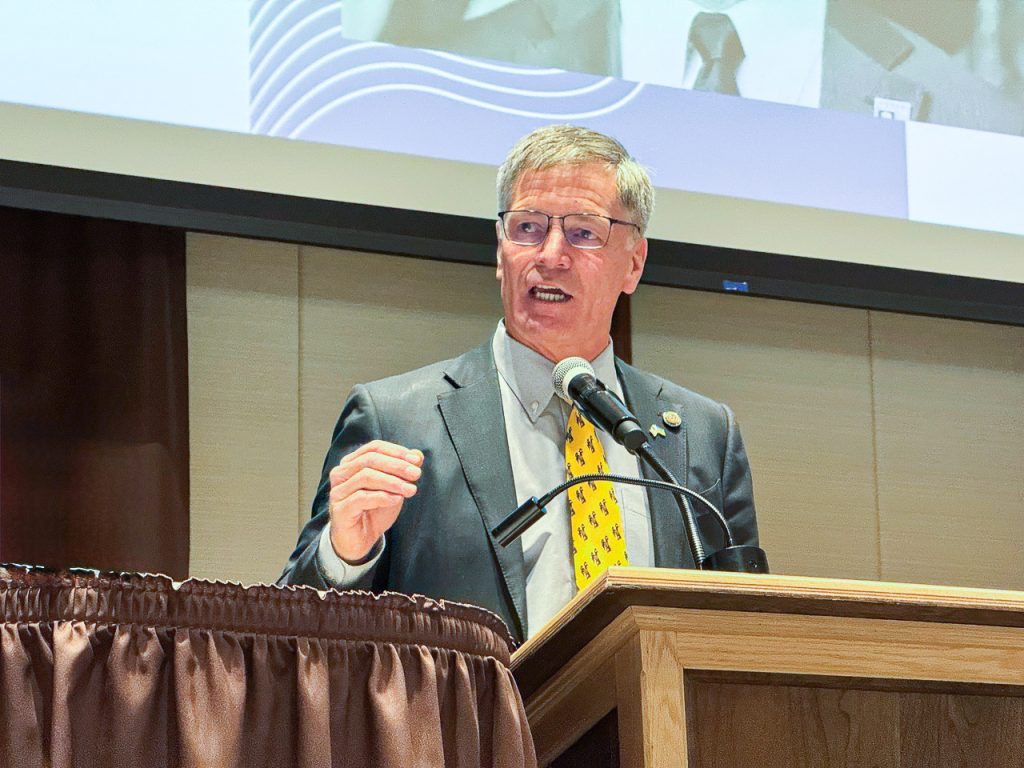
Attendees enjoyed a variety of programming highlighted by a keynote address from Gov. Mark Gordon, panel discussions on ethics and reclamation and a presentation on land use rights and management from a Wyoming rancher.
Agriculture and energy
To kick off the conference, UW CALSNR Farm Credit Services of America Dean Kelly Crane and SER Acting Director Scott Quillinan delivered a welcome address focused on the importance of collaboration between agriculture and energy in Wyoming, placing particular emphasis on preparing the next generation to lead within this critical intersection.
“One of Wyoming’s distinctive competitive advantages is we do a better job of balancing ag, recreation, wildlife habitat and energy development than anyone else,” Crane said. “UW is poised to make sure the next generation understands the importance of collaborating among all of these uses, which is part of the reason for this conference today.”
“Wyoming really does power our nation, but this puts the burden back on us here,” Quillinan added. “The land use required to power our nation falls upon folks here at home, which is why it’s so important to continue to collaborate.”
“From the university’s perspective, we are training the next generation of industry leaders, policymakers, ranchers, farmers, wildlife and water resource managers, legislators and regulators,” Crane continued. “We take pride in being a headwater state.”
Keynote address
Gordon delivered a keynote address focused on the critical intersection between energy and agriculture in Wyoming, highlighting the Cowboy State’s leadership in navigating these sectors in a productive, collaborative manner.
“The nexus between agriculture, natural resource management and developing our natural resources for the benefit of all is something Wyoming can do better than anywhere else,” Gordon said. “The people in this state – the developers, the landmen, the ranch owners and others – have a habit of trying to get things done.”
Emphasizing the Cowboy State’s close community ties, Gordon highlighted a statewide attitude of collaboration and shared respect regarding resource development which sets Wyoming apart from other states.
His comments reflected the importance of involving stakeholders, policymakers and the people of Wyoming in conversations to secure clean air, functional water resources, abundant energy and a bright future for the next generation as energy development continues to advance.
To underscore the importance of unity while navigating the developing energy landscape and bringing a positive attitude to developing conversations, Gordon discussed the Thunder Basin National Grassland as an example of successful collaboration between the U.S. Forest Service, Bureau of Land Management, oil and gas companies and local ranchers.
“This conversation didn’t happen because of what the government said,” Gordon emphasized. “It happened because the people on the ground respected each other, came together and understood they had to bury some hatchets in order to make progress.”
“This is a time with more challenges, but also more tools we can use to address those challenges as long as we keep our direction and our view bright,” Gordon added.
In closing, Gordon commented on the advancement of artificial intelligence (AI) technology, recommending people take advantage of the tool as a “tactical advantage” in synthesizing information while also value-checking outputs against learned knowledge.
“There’s a lot of conversation around how AI is going to revolutionize everything,” Gordon acknowledged. “When we think about how these tools are going to be meshed into what our future looks like, thinking strategically and being able to move forward is key.”
Additional highlights
The RMLRMC also featured a panel discussion on ethics moderated by Jacob Haseman, chairman emeritus of the UW Professional Landman Industry Advisory Board.
Panelists included Mark Eisele, former National Cattlemen’s Beef Association president and owner of King Ranch outside of Cheyenne; Callie Burch, surface landman with Continental Resources and Doug Stark, interim director of UW RMAL.
“Ethics are generally not the law, but they certainly inform the law and professional legal business conduct in almost all professions,” Haseman emphasized. “Ethical principles – honesty, integrity, loyalty, fairness, impartiality, candor fidelity and trust – help maintain personal integrity and public trust.”
Eisele, Burch and Stark commented on the importance of ethics in business and personal relationships, emphasizing Wyoming’s shared attitude of integrity and trust and how adhering to an ethical code drives success.
In the afternoon, a panel discussion shifted conversation to reclamation and restoration featuring Greyson Buckingham, chief executive officer and president of DISA Technologies; Josh Oakleaf, project manager with Wyoming Department of Environmental Quality’s abandoned mines division; Timothy Hoelzle, deputy director of the U.S. Department of the Interior’s office of restoration and damage assessment and Joshua Sorensen, reclamation program manager at Jonah Field in southwestern Wyoming.
The panel was moderated by UW Interim Associate Dean and Wyoming Agricultural Experiment Station Director Brian Mealor and guided by questions submitted by UW students.
The day concluded with a presentation on land use rights and land management from Pete Arambel, owner and operator of the Midland Ranch, a large-scale sheep and cattle grazing operation located in southwestern Wyoming.
Arambel’s comments focused on ensuring a resilient future for energy and ag in Wyoming through sustainable production practices and informed cooperation, with an emphasis upon implementing land management practices which fit the operation to the environment rather than the environment to the operation.
Grace Skavdahl is the editor of the Wyoming Livestock Roundup. Send comments on this article to roundup@wylr.net.