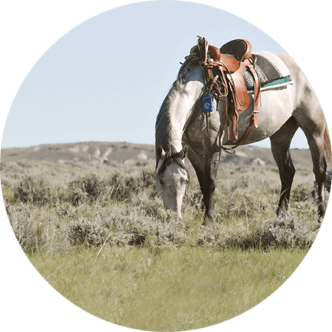
Sheep, Stewardship, Staying Power: Four generations of Camino family carry on sheep industry legacy
Among the rolling plains of Johnson County, where weather, drought and predators test even the most seasoned livestock producers, the Camino family has humbly built a sheep operation defined by resilience, adaptation and deep generational roots.
Camino and Son is a fourth-generation sheep outfit with rich Basque heritage run by Peter John Camino and his son Kirby who is prepping to take the reins.
Humble beginnings
The Camino family’s story dates back to 1908 when Peter John’s grandfather John Camino, a Basque sheepherder, arrived in the U.S.
After several years of working for other sheep operations, he saved up enough to start his own, laying the foundation for what would become a multigenerational enterprise.
“My grandfather started it, my dad Peter Camino took it over, then I took it over and now Kirby and I are both running it. He’s going to take over here pretty soon,” Peter John states.
Today, Camino and Son runs approximately 3,000 head of Rambouillet breeding ewes, a breed Peter John says is well-suited for the wide-open range in northern Wyoming.
“Rambouillets are more of a herding sheep, and they adapt well to the country we run in,” he explains. “We’ve also really focused on improving wool, and our Rambouillets have really fine wool now too.”
The operation retains ownership of its lambs from birth through harvest, feeding them out to market weight before shipping to a processing plant. Wool is marketed separately.
“We used to work with Mountain Meadow Wool until COVID-19 hit and they had to slow down, but as soon as they get their feet back on the ground, we’ll probably go back to marketing our wool through them,” Peter John says.
Chasing production goals
On the production side, Camino and Son focuses on improving its lambing percentage, with the goal of reaching a 150 to 160 percent lamb crop.
“This is probably the biggest goal we’re working on right now,” Peter John shares.
To accomplish this, the operation has partnered with University of Wyoming (UW) researchers and industry experts to examine mineral nutrition, water quality and feed efficiency.
According to Peter John, recent testing revealed a copper deficiency on the operation caused by naturally-occurring minerals in the soil which block copper absorption.
“Sheep need a certain amount of copper for their bodies to function, but we found out we have a copper deficiency in this area,” he explains.
Water quality on the ranch is also under review, as high iron levels can further interfere with mineral intake.
“We’re doing a water quality study now to see if it’s affecting our breed up as well,” he says.
In addition, the Caminos have worked closely with feeders to improve lamb performance in the feedlot, with a focus on faster gains and optimal finish weights without excess fat.
“We’ve really improved efficiency, and it’s made a big difference,” he says.
Out on the range
Furthermore, Peter John shares Camino and Son’s grazing strategy reflects the geography that makes Johnson County so unique.
During winter months, the flock grazes the flats near Powder River and Nine Mile. When summer arrives, sheep are trailed to high elevation mountain pastures near Red Fork.
“This enables us to almost double our flock size,” Peter John notes. “We are able to rest pasture on the flats in the summertime, then go to the mountains and let that ground grow back.”
However, Peter John says this carefully balanced system was tested in recent years when the House Draw Fire burned through roughly 90 to 95 percent of the operation’s pasture, forcing the Caminos to split their flock and rest affected ground.
“We had to adjust pretty quick,” Peter John says. “We split our flocks and went two different ways to work around it. We are letting burned ground rest for two years before we go back to grazing it. It’s definitely been a challenge.”
In addition, Camino and Son contends with a familiar list of challenges felt across the sheep industry.
“Our biggest challenges are weather and predators,” Peter John states, noting coyotes remain the largest threat, although eagles are now becoming more of an issue on his operation as well.
Influential leadership
On top of running a thriving operation, Peter John has also taken on numerous leadership roles at the county, state and national levels.
He has served as president of the Johnson County Predator Board, Johnson County Wool Growers Association and Wyoming Wool Growers Association (WWGA) and completed two three-year terms on the American Lamb Board.
Peter John shares one of his proudest accomplishments came during his tenure with WWGA when the organization underwent a major reorganization.
“It took me three years to get it done,” Peter John says. “This was probably one of the biggest things I’ve been involved with.”
Another milestone Peter John mentions was helping to bring a sheep specialist back to the state of Wyoming after more than two decades without one.
In partnership with UW, Peter John and other industry leaders successfully advocated for renewed Extension support and were able to hire UW Extension Sheep Specialist Dr. Whit Stewart who has been instrumental to Wyoming’s sheep industry for the past several years.
“He has been a huge help to the industry, and it’s probably another one of my greatest accomplishments – certainly one I’m really proud of,” Peter John concludes.
Hannah Bugas is the managing editor of the Wyoming Livestock Roundup. Send comments on this article to roundup@wylr.net.