Red Canyon Ranch: Brock Hanson and family advance ranching history near Big Horns
Brock Hanson and his family live on a historic ranch near Kaycee, which has been in his family for several generations.
“Where I’m living now has been in my mother’s side of the family since her grandparents,” says Brock. “My great-grandparents Albert Lafayette ‘A.L.’ Brock and Julia Brown came to this area in 1884 from Missouri and homesteaded 10 miles south of Buffalo.”
Moving to Wyoming
Brock says A.L. and Julia hit the Bozeman Trail at Fort Fetterman and followed it in their wagons. A.L. would often go around the camps and visit with freighters, asking where the best place to homestead would be.
They told him a good place would be near the mountains south of Buffalo because the area had the best water and grass and the mildest winters.
The family homesteaded near Kelly Creek, spending their first winter in a tent before building a cabin.
In the early years, A.L. made a living taming “outlaw” horses and working as a logger.
He hitched harnessed horses and dragged logs off of the mountain to supply materials for settlers’ houses, barns, fenceposts and telegraph poles.
“He brought out the poles to build over 100 miles of telegraph line,” says Brock. “This is how he got his bills paid.”
Six years after arriving, the Brocks sold their original homestead and bought a place further south. The place was purchased in 1890 and is still in the family today.
Johnson County War
The Brock place was purchased just before the Johnson County War heated up. The conflict started when big cattle companies owned by eastern and foreign investors grew resentful of homesteaders competing with them for grass, land and water rights.
The war lasted from 1889-93, and Brock says it came to a head when Johnson County was invaded by 50 gunmen – 20 Texans and 30 Wyoming men – hired by the big ranchers.
“They killed Nate Champion and Nick Ray at the KC cabin on their way north to Buffalo,” says Brock. “Their plan was to hang Sheriff William ‘Red’ Angus, the county commissioners and anyone else on their list of 70 names.”
Word was received in Buffalo prior to the attack, and the homesteaders held their own.
A three-day gun battle ensued at the fortified TA Ranch, and ended when President William Henry Harrison ordered the U.S. Cavalry to rescue the “invaders.”
Continuing to build
In 1893, the Brock family started a post office from the corner of their cabin. With the stage stop and post office, Brock says his great-grandparents got to meet everyone who came through that part of the country.
The Brocks bought more ground as it became available and held onto what they already had throughout the homestead era.
Brock says his father’s side of the family homesteaded in Niobrara County, and two of Brock’s brothers continue to manage ranches in the area.
He says his dad worked hard to hold everything together and was able to put together four ranches to pass on to each of his sons.
“When we get together at brandings it’s like a big family reunion,” Brock says.
Brock and his family have been operating on the Red Fork of the Powder River since 1975.
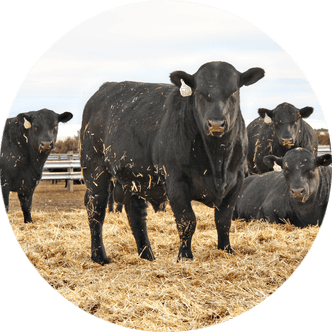
“We raise mostly Black Angus cattle even though the family raised Herefords for 100 years,” says Brock.
He further notes the operation utilizes Hereford crosses, which has worked well.
“I like Angus cows and Hereford bulls,” Brock says. “The cows hold up better, and we get more years out of a Hereford bull.”
Current operations
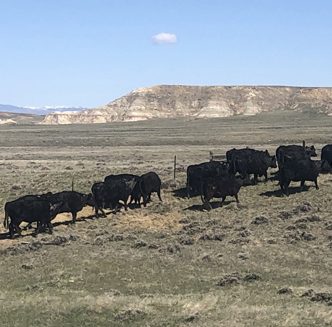
Today, the area chosen by Brock’s ancestors continues to support cattle production. The country is well-watered with mild winters and enables the family to keep raising cattle.
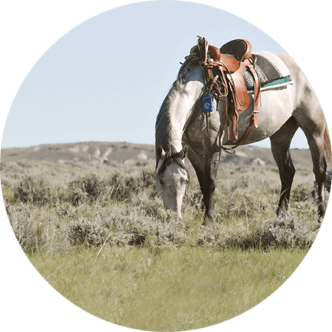
Brock says the ranch uses a lot of horses as the country can be rough. While four-wheelers are nice in flatter country to haul salt or fix fence, using them on the mountain is more dangerous than a horse.
“If you have a wreck, they don’t care if they roll over on you, whereas a horse will try to step over you and not land on you,” he says.
Brock notes cattle today keep getting a little larger. However, he tries to maintain moderate-framed animals when culling, since smaller cows are more efficient.
“We have started feeding our heifer calves some cake and grass hay in mid-December, but the cows can usually graze longer into the winter,” he notes. “We have fairly mild winters here at the base of the Big Horn Mountains.”
Brock emphasizes his great-granddad chose a good place. He also says he’s put in miles of pipe to increase water access everywhere.
“My dad said the best inventions he ever saw in his lifetime were plastic pipe and submersible pumps,” Brock says. “A lot of the sheep country here has become cow country because of this.”
Several of Brock’s family members including his siblings, children and grandchildren also live in the area and help out on the ranch often.
“My son Leif and daughter-in-law Summer have three kids and they help on the ranch,” he says. “Their girls are pretty young, but they’re good hands on a horse and they really enjoy it.”
“The work on a ranch is never ending but it’s a great life,” Brock continues. “This ranch and region have a very colorful history.”
Heather Smith Thomas is a corresponding writer for the Wyoming Livestock Roundup. Send comments on this article to roundup@wylr.net.