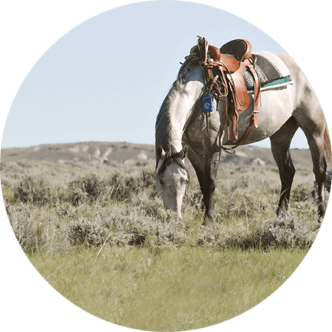
Klondike Ranch: Guest ranch offers glimpse into working cowboy life
The Klondike Ranch is a working cattle operation and guest ranch nestled among the cottonwood trees lining Crazy Woman Creek.
It was established in 1886 and sold to a prospector from the Klondike Gold Rush years later, where it took on the name it still carries today.
Richard and Patty Tass operate this historic ranch, which has been in Richard’s family since 1920.
The Tasses raise Gelbvieh and Angus cattle and offer an authentic Western experience to guests who visit.
Early years
“Our family has been on this ranch for 105 years,” Richard says. “My grandparents came from Hinckley, Minn. in 1918 and homesteaded about 15 miles from our present-day ranch.”
“The first winter on the family homesteads was tough,” Richard adds. “My grandfather and his sons went back to Minnesota where the rest of the family was still farming and put up hay there to ship to the Wyoming homesteads.”
The hay was shipped to Buffalo by train, then hauled 15 miles into the hills where the homestead was located. This gave the family enough hay to winter their milk cows and a few horses, but it was a temporary solution.
“My granddad proposed either selling the homesteads and going back to Minnesota or selling the farm and finding a ranch in Wyoming with a hay base that could grow hay for the homesteads,” says Richard.
They decided to stay in Wyoming, and Richard’s grandfather purchased the Klondike Ranch in 1920.
The ranch sprawled across nearly 600 irrigated acres at the time.
The ground’s proximity to Crazy Woman Creek made for easy irrigation and allowed the family to grow hay. Its location near the railroad also allowed another business venture to take hold.
New enterprise
From about 1915-20, Richard says many guest ranches were started around Sheridan and Cody on both sides of the mountains.
“At the time, railroads were promoting tourism and guest businesses just like the airlines do today,” Richard explains.
The family decided to get into the guest ranch business and built up a thriving enterprise before the Great Depression hit.
“They went up to the mountains and cut down trees with an ax in mid-winter, then dragged the logs down the mountain with a team of horses and built cabins,” Richard says, noting the ranch could accommodate 75 guests at a time.
Traveling was a big undertaking back then, so guests would often stay four or five weeks at a time.
A group of young women from Chicago known as the Klondike’s Girl Camp were frequent visitors of the ranch throughout the 1920s.
The effects of the Great Depression and World War II tightened fuel supplies and travel funds which put a damper on tourism, and the ranch began to lose business.
The family dispersed and looked for work elsewhere, but Richard’s uncle continued to run cattle and sheep on the original homestead.
Richard’s parents Leo and Mary briefly moved to New York City where Leo helped build the George Washington Bridge.
Leo also worked on dams in Arizona and Alcova, and eventually the couple returned to Wyoming full time to take over ownership of the Klondike Ranch in 1943.
Present day operation
Richard and Patty were married in 1971, shortly after Richard returned from the Vietnam War.
They’ve spent most of their married lives on the Klondike Ranch raising cattle and running the guest business which is once again thriving.
“My wife and I have been married 54 years and have been running the guest ranch for 35 of those years,” Richard says. “We do week-only stays, and our guests like to ride and help us take cows to the mountains.”
Today, Klondike Ranch has grown to about 1,000 acres. It has five cabins and hosts a maximum of 10 guests at a time.
“We spend a lot of time with our livestock and a lot of time with our guest business, which keeps us in the cow business,” he says.
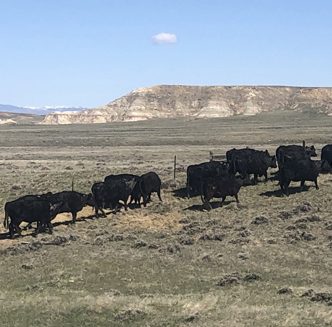
The ranch has a mountain grazing permit on the Bighorn National Forest. Guests get the opportunity to help with ranch work, and they particularly enjoy helping with cattle drives.
“People think we are crazy taking guests up there, but they love it,” Richard says. “We take eight to 10 people at a time to a camp up there. It’s a unique experience for them, and it helps us stay in the cow business.”
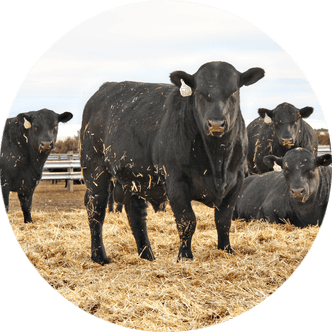
The cow herd is mostly Gelbvieh with some Angus influence.
“We like the Gelbvieh because they milk well and have better disposition than Angus,” Richard says. “Since we are a small operation and work with cows all the time, we need to have cattle that are easy to handle and won’t put us up the fence.”
“We can walk out in the pasture, and they come up to us. Some of them will even let me scratch their heads,” he continues. “We’ve kept our own replacements for 40 years, and they are the kind of cattle we want.”
Five generations
The Klondike Ranch has been in Richard’s family for five generations.
His son John lives on the ranch and helps with operations, along with his two children.
Richard says his grandchildren are all doing well, and he hopes to see another generation eventually return to the ranch.
For more information on Klondike Ranch, visit klondikeranch.com.
Heather Smith Thomas is a corresponding writer for the Wyoming Livestock Roundup. Send comments on this article to roundup@wylr.net.