A Legacy of Conservation: Stoltz family honored with 2026 Environmental Stewardship Award
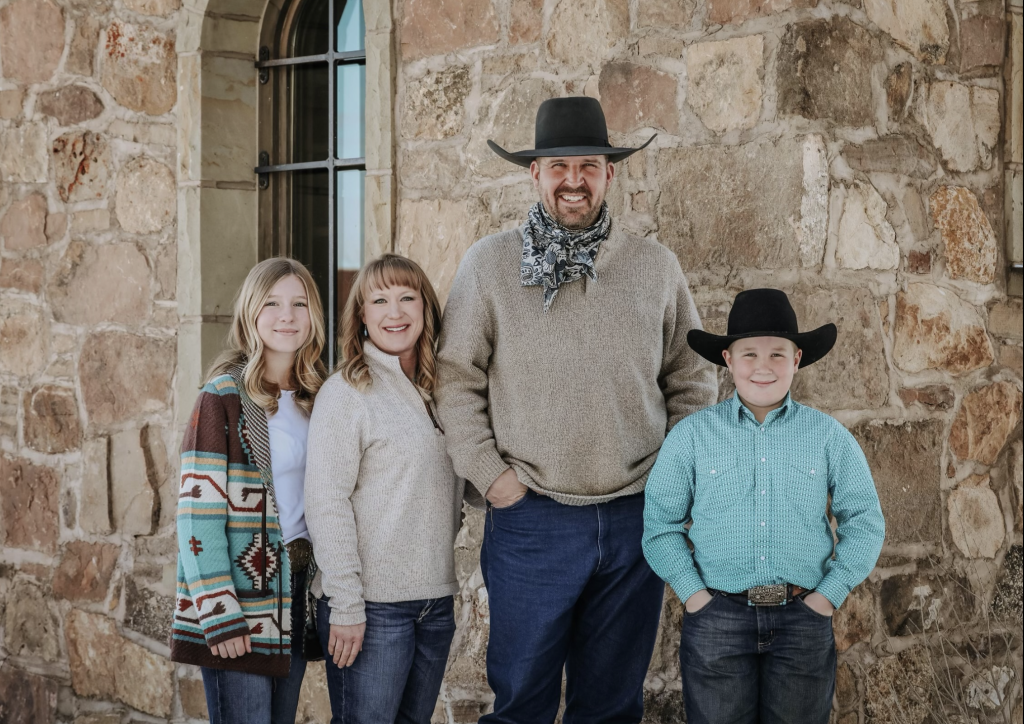
Stoltz Cattle Company LLC, owned and operated by Thad and Heidi Stoltz, is a decade-old ranching operation in northeastern Wyoming proving innovation and tradition are powerful partners – not opposing forces.
In recognition of their conservation efforts, the Stoltz family was selected as the recipient of the 2026 Environmental Stewardship Award, granted each year by the Wyoming Stock Growers Association – in partnership with the Wyoming Department of Agriculture and
Audubon Rockies – to recognize a Wyoming ranch whose natural resource stewardship practices contribute to environmental sustainability while simultaneously enhancing the operation’s productivity and profitability.
Building a future
Spanning Johnson and Sheridan counties, the roots of the Stoltzes’ ranching operation trace back to 1907 when Heidi’s great-great-grandfather Alva Lorah homesteaded the land. Heidi’s great grandparents Santiago and Ethel Michelena carried on the family legacy, putting together additional tracts of land.
Through decades of family transitions and periods of leasing, the ranch remained intact waiting for the fifth generation to return to the ranch.
This moment came in 2009 when Thad and Heidi moved to the ranch with little more than a truck and bale bed, a horse trailer, a skid steer, unwavering determination and a vision for the future.
“Initially, Heidi worked full time as a nurse to support their transition, joining Thad full time on the ranch in 2019,” reads the nomination form. “Together, they became the first family to work the ranch since Heidi’s great-grandparents.”
Today, the Stoltz family operates two interconnected businesses – GGM LLC, a land company owned by Thad, Heidi and Heidi’s mother Marie Miller, and Stoltz Cattle Company LLC, the couple’s operating business.
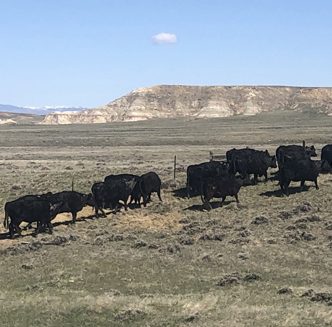
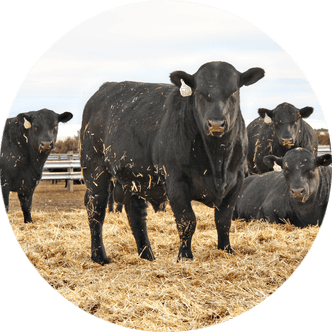
Cattle provide the primary source of income for the operating business, with approximately 500 Angus-cross cow/calf pairs and 300 yearling replacement heifers grazed annually on both deeded and additional leased ground, adjusting herd size based on moisture and forage conditions. The Stoltz operation markets steer calves in the fall, develops bred heifers and sells bred cows seasonally.
Thad and Heidi’s children, 15-year-old Jayden and 13-year-old Kreyton, are also heavily involved in everyday operations, managing their own herds and actively participating in 4-H.
According to the nomination form, Thad and Heidi have made it a priority to ensure their kids are learning more than just how to do ranch chores – they are also learning the how and why behind many of the family’s ranch management decisions.
“Thad and Heidi prioritize education, attending programs like Ranching for Profit, grazing schools and soil symposiums, and they pass this knowledge on to their children. From money and herd sized adjusted management to grazing strategies, the kids are actively involved in both the physical and financial aspects of ranching,” the nomination form reads.
Implementing adaptive grazing
When Thad and Heidi took over operations in 2009, they quickly realized managing their dryland range would require them to approach things differently than the “status quo.”
In an effort to better manage their land and business, they utilized knowledge gained at Ranching for Profit sessions and multiple grazing schools to create innovative solutions.
Today, what once consisted of six large pastures has evolved into 36 paddocks separated by high-tensile electric cross fencing. Grazing periods now range from two days to thirty days, depending on size of paddock and season of growth. Graze periods are followed by long rest periods often exceeding 13 months.
Pastures are grazed at different times each year, with constant monitoring to adapt to weather and plant readiness. The Stoltzes also aim to leave adequate residual forage after grazing in each pasture.
“By closely monitoring weather patterns and the readiness of each pasture, they adjust grazing plans as needed. If a pasture isn’t ready, they graze elsewhere until conditions improve,” the nomination form reads. “This adaptive grazing management has resulted in improved soil health, forage production and overall ecosystem resilience.”
Safeguarding water, wildlife and soil health
Water development has been another cornerstone of the Stoltz family’s stewardship strategy.
With limited live water and reservoirs impacted by persistent drought, Thad and Heidi have worked to expand infrastructure to support both livestock and wildlife.
The ranch now includes approximately 25 miles of pipeline, five wells and storage capacity exceeding 100,000 gallons, all of which support grazing distribution and sustain a variety of wildlife species including antelope, elk, mule deer, white-tailed deer, coyotes, bobcats, prairie dogs and sage grouse.
Equally central to the Stoltz’s philosophy is soil health.
“Thad and Heidi have become very committed to improving soil health,” the nomination form reads. “Their goal is to create an environment where all of God’s creations flourish, and they believe it all starts with the soil.”
“They choose to manage their land in a way that will nurture one of the most valuable natural resources they have,” the form continues. “Thad and Heidi use soil health as a decision base for major ranch decisions such as enterprise mix, stocking rates and when and how they substitute feed.”
In a letter of support, Allison McKenzie, Johnson County district manager for the U.S. Department of Agriculture’s Natural Resources Conservation Service, notes the couple has completely eliminated traditional pour-on dewormers to protect dung beetles and soil microorganisms, increased stock density to break capped soils and prioritized ground cover through litter and manure distribution.
Participating in collaborative research
The Stoltz family’s commitment to stewardship doesn’t just exist within the confines of their fencelines.
In fact, they are active participants in the Metrics, Management and Monitoring research project, which analyzes the linkages between pasture and rangeland soil health, management practices and producer well-being through collaboration between the University of Wyoming (UW), the Noble Research Institute and other partners.
Among 19 ranches across Wyoming and Colorado
participating in the project, the Stoltz operation achieved the highest ecological health score – a measure of water and mineral cycling, energy flow and biodiversity.
“This project demands a significant investment of time and engagement, and the Stoltzes have consistently approached it with enthusiasm, a positive attitude and a willingness to network with fellow ranchers,” says Nicki Nimlos, a UW PhD student who nominated the Stoltzes.
“Their commitment to this project is truly exceptional, as they not only embrace the opportunity to improve their own management practices but also contribute valuable insights to the broader ranching community,” she adds. “This level of enthusiastic participation is rare, particularly when working with academics, making the Stoltz family a standout example of dedication and collaboration.”
Researchers have noted measurable improvements in soil moisture retention, forage productivity and ecological function, supported by both on-the-ground monitoring and remote sensing data.
Protecting a legacy
For Thad and Heidi, stewardship has become inseparable from legacy, and arguably one of the most extraordinary aspects of the ranch – which has been recognized by the Wyoming Centennial Farm and Ranch program for operating over 100 years – is that it is now home to the sixth generation.
“Heidi’s family has fought hard to keep the ranch in the family. This dedication has allowed the ranch to continue as a multi-generational operation, ensuring it remains in agriculture and a family business for future generations, which is something Thad and Heidi are incredibly grateful for,” the nomination form reads.
“Succession planning and the loss of agricultural land is a critical issue facing the ranching community, and Thad and Heidi recognize how fortunate they are to be part of such a rare success story,” it continues. “They understand the importance of planning for the next generation, and they are committed to passing on not only the land but also the knowledge and skills needed to sustain it. They are actively working to involve their children in the ranching business, preparing them to continue the legacy for years to come.”
In letters of support, multiple individuals note Thad and Heidi’s determination to leave the land better than they found it.
“Thad and Heidi’s efforts extend beyond ecological practices. They embody the social dimensions of environmental stewardship with equal passion. Their mission, beautifully articulated during an interview as ‘working in partnership with nature, animals and people to build healthy land, prosperous animals, strong relationships and a happy family,’ serves as a testament to their holistic vision,” writes Oregon State University Postdoctoral Scholar Ada Smith.
“They possess an insatiable curiosity and a growth mindset, seeking to learn more about their land through scientific data collection and analysis. In just over a decade, Thad and Heidi have advanced the ecological health of their ranch,” Smith continues. “Their commitment to education and collaboration, coupled with improved ecological outcomes, makes them highly deserving of the 2026 Environmental Stewardship Award.”
Nimlos comments, “Thad and Heidi represent the epitome of Wyoming ranching as the stewards of a multi-generational ranch in Arvada – a rare and remarkable legacy. From growing their cow/calf operation from scratch to raising the next generation of ranchers, Thad and Heidi embody the values of hard work, dedication and sustainability.”
“Their land stewardship practices, adaptive management and commitment to conservation make them truly deserving of this prestigious recognition,” Nimlos concludes.
Hannah Bugas is the managing editor of the Wyoming Livestock Roundup. Send comments on this article to roundup@wylr.net.